
Build an effective Pilates routine at home with minimal gear
PHOEBE COLE
You want the benefits of Pilates: stronger core, better posture, more flexible hips. But you also have a small apartment, a tight budget, and zero interest in hauling a reformer machine through your front door. The good news is you don’t need any of that. A focused, well-structured home Pilates routine built around portable equipment and smart programming can deliver real, measurable results in the space of a yoga mat. This guide walks you through exactly how to set it up, from the first prop you need to the last rep of your session.
Table of Contents
- Essentials for building a home Pilates routine
- Step-by-step: Your beginner Pilates flow at home
- Modifications, progression, and troubleshooting
- Maximizing results in minimal space: Portable props and creative tips
- Our take: Why consistency and not equipment matters most for home Pilates
- Ready to deepen your at-home Pilates journey?
- Frequently asked questions
Key Takeaways
| Point | Details |
|---|---|
| Space-efficient Pilates is possible | You can create a full Pilates routine at home using minimal space and portable equipment. |
| Consistency beats equipment | Sticking to a regular routine delivers lasting results more gear is optional, not required. |
| Customize for your needs | Adapt your routine with modifications and props for safety, comfort, and continued progress. |
| Portable props add variety | Resistance bands, mini weights, and compact kits can simulate reformer moves without heavy machines. |
Essentials for building a home Pilates routine
Now that you’re set on bringing Pilates home, let’s start with what you actually need for a space-saving and safe exercise routine.
Space and surface basics
The minimum working area for most Pilates exercises is about 6 feet long by 3 feet wide. That fits a standard yoga mat with a little breathing room for arm and leg extensions. A firm, carpeted floor or a non-slip mat on hardwood works well. If you’re doing exercises where your head or tailbone touches the floor, keep a folded towel or small pillow nearby for support.
A beginner mat fundamentals approach means you can structure your routine in a time-based flow with controlled reps, which works perfectly in small spaces. You don’t need a dedicated studio room. A cleared living room corner, a bedroom floor, or even a hotel room is enough.
Core portable props you’ll actually use
Not all props are worth the cabinet space. Here’s a focused list of what earns its place:
- Resistance bands: Light, medium, and heavy options give you a full range of resistance for legs, arms, and back work
- Ankle straps or foot loops: These attach to door anchors and let you replicate cable-machine movements
- Door anchors: A small loop that closes in any standard door frame, giving you a fixed anchor point for pulling and pushing movements
- Mini loop bands: Great for hip abduction, glute bridges, and lateral leg work
- Small hand weights (1 to 3 lbs): Optional but useful for arm series and standing sequences
- Foam roller: Doubles as a spine support and a mobility tool
For travel or small-space setups, consider compact exercise equipment that packs into a single tote bag. The difference between a home setup and a travel setup is mostly about what you can afford to leave behind. At home, keep everything in one dedicated bin or bag so setup takes under two minutes.
Safety checks before you begin
Good form starts with a safe environment. Before each session, scan for these:
- Enough clearance overhead for arm raises (minimum 7 feet ceiling height for standing work)
- No slippery socks on hardwood (bare feet or grip socks only)
- Door anchor secured before applying any resistance
- Phone or water within reach, but not in your movement path
The Pilates workout tips approach emphasizes setup as part of the practice itself. A few minutes of prep prevents most injury risks. Following Pilates-like slow, controlled movement with targeted core engagement, using your space and props to support safe form, is the standard to aim for every session.
Gear comparison: What works where
| Setup type | Space needed | Key props | Best for |
|---|---|---|---|
| Mat only | 6 x 3 ft | Mat, towel | Total beginners, travel |
| Mat + bands | 6 x 3 ft | Mat, bands, anchor | Home workout, intermediate |
| Full portable kit | 6 x 4 ft | Bands, straps, anchor, weights | Advanced home training |
| Studio reformer | 10 x 4 ft | Reformer machine | Professional settings |
The Pilates Mini Starter Kit covers the middle ground well: portable enough for travel, complete enough for a serious home workout.
Pro Tip: Set up your “Pilates zone” the night before. Place your mat, props, and water bottle in position so you step into the space ready to move. Zero friction at the start means fewer skipped sessions.
Step-by-step: Your beginner Pilates flow at home
Once you’ve gathered your essentials, it’s time to build a practical flow you can do anywhere. Here’s a beginner sequence tailored for small spaces.

The 10-move home Pilates flow
Aim for 6 to 10 slow reps per exercise, or 30 to 60 seconds for timed holds. Move through the sequence with a focus on breath first, range of motion second.
- Diaphragmatic breathing (60 seconds): Lie on your back. Inhale through the nose to expand the ribcage laterally. Exhale slowly. This activates the deep core before anything else moves.
- Pelvic tilts (8 reps): Neutral spine to posterior tilt and back. Keeps the lumbar spine mobile and warms up the deep abdominals.
- Imprinting (6 reps): Press each vertebra gently into the mat in sequence from tailbone to lower back. Builds body awareness before loading the spine.
- Glute bridges (10 reps): Feet flat, hip-width apart. Press through heels to lift hips. Add a mini band above the knees for an extra challenge.
- Cat-cow (8 reps): On hands and knees, arch and round through the spine in sync with breath. Prioritizes spinal positioning and neutral control before moving to more demanding exercises.
- Toe taps (10 reps each side): From tabletop position, lower one foot toward the floor while keeping the pelvis still. This is a core stability exercise, not a leg exercise.
- Single leg stretch (8 reps each side): Lie on your back, knees to chest. Extend one leg out while pulling the other in. Keep your head and shoulders lifted if you can.
- Spine stretch forward (6 reps): Seated, legs extended. Reach forward over your legs with a rounded spine. Stretches the posterior chain.
- Standing hip circles (10 each direction): Stand tall, hands on hips, draw slow circles. Builds balance and hip mobility together.
- Standing balance (30 seconds each leg): Single leg hold with a straight spine. Use a wall for light support if needed at first.
Frequency and scheduling
Pilates at 2 to 3 sessions per week gives most beginners enough stimulus for steady strength and flexibility gains without overloading recovery. Spreading sessions across the week (for example, Monday, Wednesday, Friday) gives your connective tissue time to adapt. For routine scheduling advice, pair Pilates days with lighter activity like walking on rest days rather than stacking them with intense cardio.
Sequence comparison: Mat vs. props vs. portable kit
| Format | Warmup | Core focus | Resistance | Duration |
|---|---|---|---|---|
| Mat only | Breathing, pelvic tilt | Toe taps, single leg stretch | Bodyweight | 20 to 30 min |
| Mat + props | Same + cat-cow | Bridges with band, spine stretch | Band/loop | 30 to 45 min |
| Pilates Mini Reformer Kit | Full warmup | Full sequence with anchored pulls | Band + strap | 40 to 50 min |
Pro Tip: Never rush reps to hit a number faster. Two slow, controlled reps with full breath and no momentum beat ten fast, sloppy reps every time. Speed is the enemy of Pilates form. Check beginner workout tips for more technique guidance.
Modifications, progression, and troubleshooting
Every home workout needs to adjust with you as you improve, or when you need more support. Here’s how to tweak and troubleshoot your routine for success.
How to progress safely
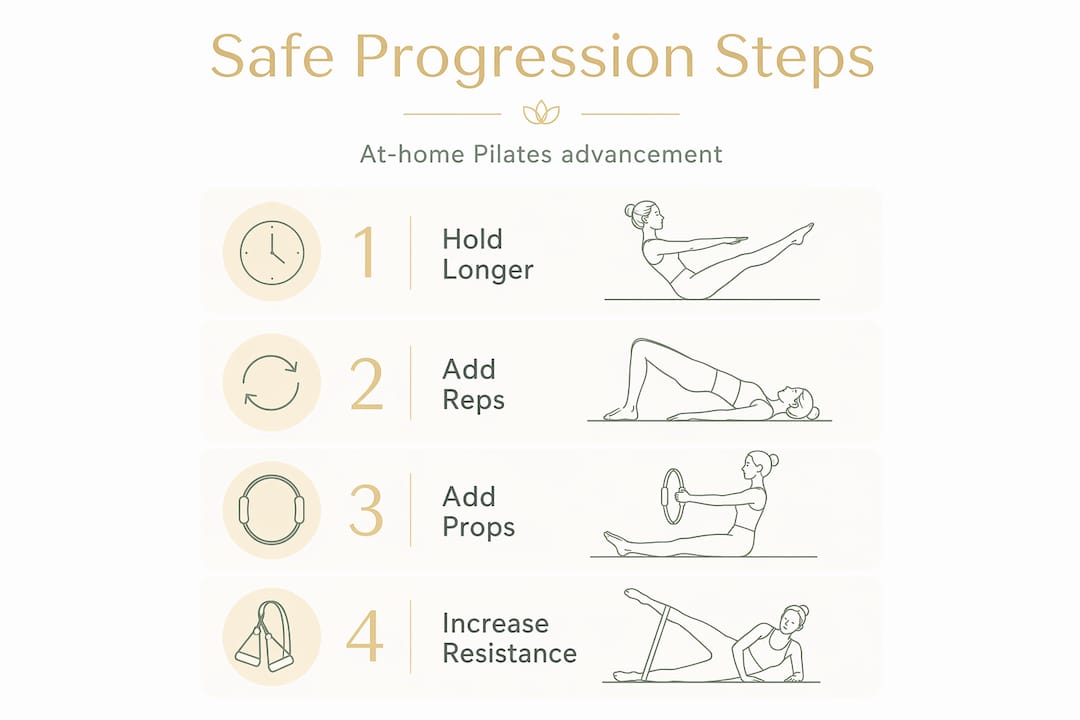
The safest progression order is: extend time under tension first, then increase reps, then add props or resistance. Only move to the next level when you can complete the current challenge with full control and no compensation (like arching your back or holding your breath).
For example, once glute bridges feel easy, add a mini band above the knees. Once that feels controlled, move to single leg bridges. This layered approach, which starts with bodyweight and slow reps before adding props, matches a sound at-home progression plan.
Beginner modifications by issue
- Neck tension during ab work: Place one hand behind your head for support, or skip head lifts entirely and focus on the leg movement only
- Tight hamstrings in spine stretch: Bend your knees slightly. The goal is a rounded spine, not straight legs
- Wrist pain in quadruped (hands-and-knees) positions: Use fists instead of flat palms, or place forearms on the mat
- Lower back sensitivity in leg lowering: Reduce the range of motion significantly. Keep the lowering leg much higher than you think you need to
- Balance issues in standing work: Use a wall lightly. Remove support gradually as strength builds
For lower back pain tips, focus on building deep abdominal strength before tackling more advanced spinal flexion exercises.
Important: If you experience sharp pain, sudden dizziness, numbness, or any symptom that feels wrong, stop the exercise immediately. NHS guidance on Pilates strongly advises getting advice from a healthcare professional before starting if you have chronic back pain or any pre-existing health concern, and stopping exercise if pain increases.
Common mistakes and fixes
Most home Pilates errors fall into three categories. First, rushing through reps to finish faster. Fix: count the exhale. If you’re not breathing out on the effort, you’re going too fast. Second, forgetting to engage the core before moving the limbs. Fix: draw your navel lightly toward your spine before each rep starts. Third, skipping warmup when short on time. Fix: cut reps from the main sequence, not the warmup. A cold spine moving into bridges is a setup for strain.
For users working with a door anchor setup, the doorway setup guide covers exactly how to position the anchor at the right height for each exercise type, which eliminates a lot of setup guesswork.
Pro Tip: Keep a simple session log. Write down which exercises felt off, which felt strong, and what you want to adjust next time. Even three lines of notes per session builds a clear picture of your progress over weeks.
Maximizing results in minimal space: Portable props and creative tips
If you want added challenge and flexibility, here’s how portable props and smart gear choices can take your compact Pilates routine further.
Portable equipment worth adding
Resistance bands and door anchors together are the closest you can get to reformer-style resistance without a bulky machine. The anchor holds the band at a fixed point while your body moves against it, which mimics the spring-loaded carriage of a full reformer. You can set the anchor at floor level for footwork, at mid-door for rowing, or at the top of the frame for pull-down movements.
Other portable options worth considering:
- Resistance bands (looped and long): The most versatile single prop you can own
- Ankle straps: Let you switch from hand-held to foot-driven exercises without changing the anchor
- Mini loop bands: Add lateral resistance for hip and glute work without changing your position
- Foam roller: Useful for thoracic (upper back) mobility work and balance challenges
- Small hand weights: Add a light arm series to standing sequences to increase total body involvement
- Compact carrying bag: Keeps everything organized and portable, ready to go in under a minute
Browse the Pilates Mini Essentials collection for gear that fits into a single tote and covers the full range of home and travel needs.
Creative ways to use what you have
A foam roller placed horizontally under the thoracic spine turns a basic bridge into a spinal extension exercise. A long resistance band looped around a table leg creates a makeshift cable anchor for seated rowing. A small hand towel on a smooth floor lets your feet slide for hamstring curls from a bridge position.
The point is that variety does not require more gear. It requires more creative use of what you already have.
Maintenance and storage
Wipe bands and straps with a damp cloth after each session. Store them loosely coiled or flat, not tightly knotted, which degrades the rubber faster. Check anchor points for fraying before each use. Replace any band with visible cracks or tears before it snaps under load.
For foam roller options and other compact props that store flat, look for items under 12 inches in any dimension so they fit in a standard storage cube or tote.
Pro Tip: Bundle all your small props into one zippered bag before storing. This cuts your setup time from five minutes to under 60 seconds, and 60-second setup means far fewer reasons to skip a session.
Our take: Why consistency and not equipment matters most for home Pilates
After exploring all your home Pilates options, let’s zoom out and talk about what truly leads to lasting results, regardless of gear.
Here’s something that doesn’t get said enough: a mat, a clear floor, and a twice-weekly commitment will outperform an expensive, elaborate setup used inconsistently. Every time. The research on habit formation shows that frequency of practice, not intensity or equipment quality, drives the biggest skill and conditioning gains over time.
The people who see the most noticeable Pilates results at home are almost never the ones with the most props. They’re the ones who show up regularly, work at their actual level, and build a rhythm their schedule can sustain. A repeatable Pilates routine with a fixed weekly structure removes the daily decision of “what should I do today,” which is one of the biggest invisible barriers to consistency.
Portable, compact gear plays a real role, but the right role. It removes friction. It makes setup faster. It makes travel workouts possible. It gives you variety to stay interested. What it cannot do is replace the decision to show up. Treat gear as a tool that supports your habit, not the source of your motivation.
Small space is also not the limitation it feels like. Tight corners have produced extraordinary athletes. The mat is enough to start. Add props as your practice matures and as specific needs arise. Build the habit first. The gear will find its place.
Ready to deepen your at-home Pilates journey?
You’ve got the framework. Now it’s about putting it into consistent practice with the right support around you.
The Pilates Mini Complete Starter Kit includes everything covered in this guide: resistance bands, straps, a door anchor, and a tote bag for easy storage and travel. It’s designed specifically for home and small-space workouts, so nothing is wasted and everything has a use. Pair it with expert workout tips from the site for guided technique support as you build your practice. Whether you’re starting from scratch or looking to add structure to an existing routine, the kit gives you a complete, compact foundation to work from consistently.
Frequently asked questions (FAQs)
Q: How often should I do a home Pilates routine for best results?
A: Most experts recommend starting with 2 to 3 sessions per week for general Pilates work, adjusting based on your goals and the intensity of each session.
Q: What if I have back pain or an old injury?
A: Speak to a healthcare professional before beginning, and follow NHS guidance to modify or stop your routine immediately if pain or discomfort increases during exercise.
Q: Can portable props really replace a Pilates reformer?
A: Yes. Bands, door anchors, and compact kits for reformer-style resistance can replicate most reformer benefits without requiring bulky machines or studio space.
Q: How do I know if I’m doing Pilates exercises correctly at home?
A: Focus on slow, controlled reps and steady breathing throughout. Slow, controlled movement with core engagement using proper setup and props to support form is the clearest indicator you’re on track.