
How 20-minute Pilates works: Your quick home guide
PHOEBE COLE
Most people assume Pilates requires a full hour, a studio reformer, or a certified instructor standing over them. None of that is true. Understanding how 20 minute pilates works changes the picture completely. Short, structured sessions built around slow movement and core control can build real strength and improve flexibility without any bulky equipment. This article breaks down the structure, principles, and practical steps behind effective 20-minute Pilates routines so you know exactly what to do, what to expect, and how to make every session count.
Table of Contents
- Understanding the structure of a 20-minute Pilates workout
- Core principles behind why short Pilates routines work
- How progression and consistency maximize benefits from 20-minute Pilates
- Practical tips for getting the most from your 20-minute Pilates sessions at home
- Comparing 20-minute Pilates with longer sessions: efficiency and focus
- Our take: Short workouts get dismissed too quickly
- Take your 20-minute Pilates practice further
- Frequently asked questions
Key Takeaways
| Point | Details |
|---|---|
| Effective short sessions | You can build strength and flexibility with controlled 20-minute Pilates workouts at home. |
| Structured progression | Consistency over weeks and staged intensity maximize results from brief routines. |
| Core focus is key | Precision, slow movement, and sustained core engagement drive Pilates benefits. |
| Equipment optional | Bodyweight is sufficient, with light accessories helpful but not necessary. |
| Intentional rest | Brief rest periods help maintain breath and form without passive breaks. |
Understanding the structure of a 20-minute Pilates workout
A 20-minute Pilates session is not a shortened version of a long class. It is its own format, designed from the start to fit everything essential into one focused block. Every minute has a purpose.
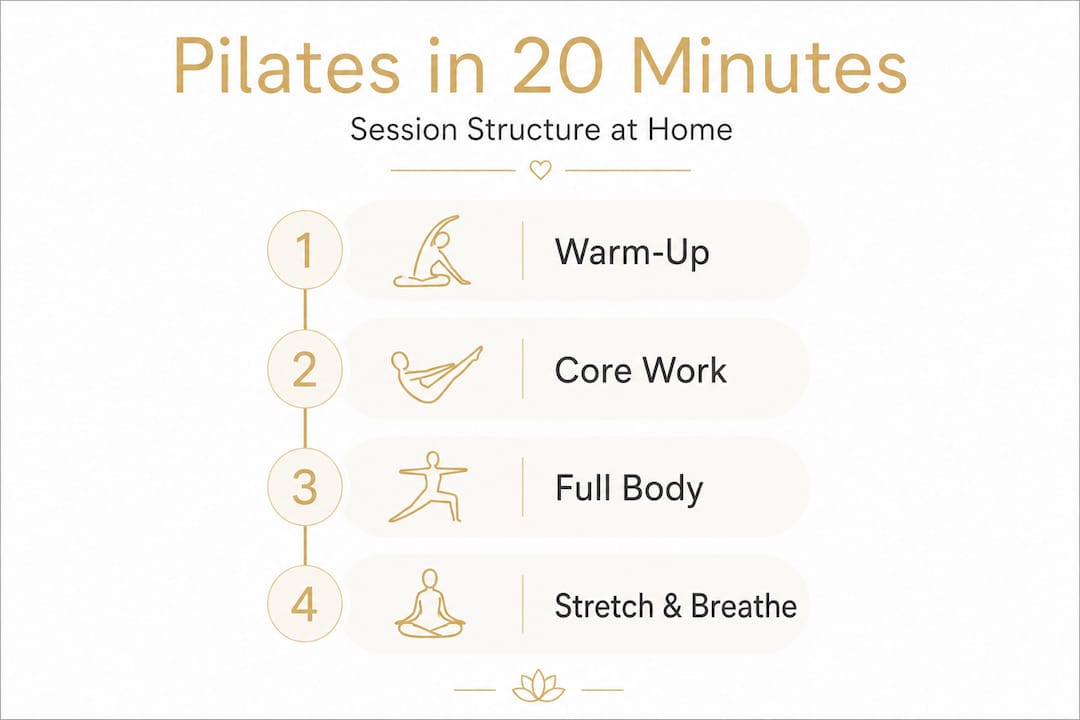
Home Pilates plans typically use a time-based structure with defined phases covering standing work, floor core and glute exercises, and balance sequences, all without bulky equipment. That structure is what separates an effective 20-minute session from a random collection of exercises.
Here is how a well-built 20-minute Pilates routine is typically organized:
- Warm-up (3 to 4 minutes). Gentle movement to wake up the spine and joints. Think slow rolls, shoulder circles, and light hip openers. The goal is blood flow and body awareness, not intensity.
- Standing series (4 to 5 minutes). Exercises performed upright that activate the legs, glutes, and postural muscles. Single-leg work and slow squats are common here.
- Floor or tabletop core work (6 to 7 minutes). This is the core of the session. Movements like the Hundred, leg circles, and bird-dog focus entirely on deep abdominal engagement.
- Seated abs and glute activation (3 to 4 minutes). Targeted work in a seated or prone position to finish the core and posterior chain.
- Balance and cool-down (2 to 3 minutes). Standing balance holds and spinal stretches close the session and restore alignment.
You do not need a reformer for any of this. A mat handles the floor work. For setting up Pilates equipment at home, even a simple doorway resistance setup can add variety to the standing and seated phases without taking up floor space.
The reason this structure works is that it mirrors the logic of longer sessions but removes the redundancy. No phase overstays its welcome. You move through the sequence with intention, and the body responds because the stimulus is consistent and complete.

Core principles behind why short Pilates routines work
Knowing the schedule is one thing. Understanding why it delivers results is more useful. The effectiveness of short Pilates workouts comes down to a handful of principles that Joseph Pilates built into the method from the start.
Slow movement activates deep muscles. Fast reps recruit large, superficial muscles. Slow, controlled movement forces the deep stabilizers, including the transverse abdominis and multifidus, to engage. Those are the muscles that protect your spine and improve posture. Speed bypasses them.
Pilates routines emphasize precision and time under control rather than speed, which builds a stronger mind-muscle connection and more effective muscle activation even within short sessions.
Here are the core principles that make quick Pilates exercises effective:
- Precision over quantity. Ten slow, precise leg raises beat thirty sloppy ones every time.
- Breath control. Exhaling on exertion and inhaling on release is not optional. It regulates intra-abdominal pressure and keeps the core actively engaged.
- Neutral spine. Most Pilates movements require you to maintain a neutral or imprinted spine position, which teaches your body correct alignment under load.
- Mind-muscle connection. You are supposed to think about what you are moving and why. This is what separates Pilates from general fitness and is what makes the benefits transfer to daily movement.
Form and core engagement matter more than fitting more exercises into a short routine. Modifications exist specifically to maintain slow control when your form starts to break down.
If you are new to this, Pilates workout tips for beginners covers how to apply these principles from day one without guessing.
Pro Tip: If you feel your lower back engaging instead of your core during floor work, reduce the range of motion by half. That small adjustment shifts the load back to the abs where it belongs.
How progression and consistency maximize benefits from 20-minute Pilates
One session will not transform your posture. Twenty sessions over seven weeks very well might. The benefits of 20 minute pilates are cumulative, and the structure you use across weeks matters as much as the structure within a single session.
Short Pilates sessions rely on repetition over weeks with staged intensity to improve strength and posture in a sustainable way. That means your week-four routine should be slightly more demanding than your week-one routine, even if both are 20 minutes long.
Here is what a sustainable progression plan looks like in practice:
- Weeks 1 to 2: Learn the movement patterns. Keep range of motion small. Focus entirely on form and breath.
- Weeks 3 to 4: Increase repetitions by 2 to 4 per exercise. Begin adding single-leg variations to familiar movements.
- Weeks 5 to 6: Introduce light resistance (bands or small weights) to standing and seated exercises.
- Weeks 7 onward: Extend holds, reduce rest between exercises, and layer in more advanced variations like the teaser or full roll-up.
Consistency matters more than session length, and 20-minute routines work best when repeated multiple times weekly within a structured program. Two to three sessions per week is the practical sweet spot for most people.
| Week range | Session focus | Intensity level |
|---|---|---|
| Weeks 1 to 2 | Form and movement patterns | Low |
| Weeks 3 to 4 | Rep increase and single-leg work | Moderate |
| Weeks 5 to 6 | Light resistance added | Moderate to high |
| Weeks 7 and beyond | Advanced variations and reduced rest | High |
A structured Pilates progression guide removes the guesswork from this process, so you are not stuck repeating the same level indefinitely.
Pro Tip: Track one exercise each week, such as how many reps of the Hundred you can complete with good form. Small, measurable gains show you the method is working even when you cannot see physical changes yet.
Practical tips for getting the most from your 20-minute Pilates sessions at home
Structure and principles get you far. Execution details get you the rest of the way. These tips apply directly to home workouts where you control the environment, the schedule, and the equipment.
- Set up a consistent space. It does not need to be large. A yoga mat’s worth of floor space is enough. Consistency in location reduces friction and makes it easier to start.
- Use a mat. Joint comfort is not a luxury. A mat protects your spine during floor work and keeps you focused on the exercise rather than the discomfort of a hard surface.
- Move slowly and deliberately. This is worth repeating because it is the most common mistake people make at home. Slowing down feels harder, which means it is working.
- Add equipment when you have it. Light dumbbells, resistance bands, or a compact reformer kit all increase variety. But every exercise in a standard 20-minute Pilates routine can be done with just your bodyweight.
Evidence-based Pilates protocols include specific rest periods between movements, around 30 seconds, to maintain breath and form without passive breaks. That is very different from stopping because you are tired. The rest is intentional: reset your spine, take two controlled breaths, then continue.
- Schedule it like a meeting. Twenty minutes is easy to skip when it feels optional. Block it on your calendar at the same time, three days a week.
- Progress your moves as you improve. If an exercise feels easy, you have outgrown that variation. Add a hold, slow down the tempo, or try the single-leg version.
For a ready-to-use home setup, complete Pilates home workout kits include everything needed to add resistance and variety to short sessions without a reformer.
Comparing 20-minute Pilates with longer sessions: efficiency and focus
A common question is whether a 20-minute session delivers anything close to what a 60-minute class provides. The honest answer is: it depends on what you need.
Clinical Pilates sessions include defined warm-up, main, and cool-down components structured by intensity, and longer sessions allow more intensity stages while 20-minute workouts preserve the essential elements for benefit.
Here is a direct comparison:
| Feature | 20-minute session | 60-minute class |
|---|---|---|
| Core engagement | Full, focused | Full, with more variety |
| Warm-up and cool-down | Included (shorter) | Included (thorough) |
| Exercise variety | Limited to essentials | Broad, with progressions |
| Suitable for busy schedules | Yes | Less flexible |
| Advanced intensity staging | Basic | Multiple stages |
| Equipment required | None to minimal | Often more options |
Short Pilates workouts are not inferior. They are a different tool. For someone building a home practice, 20 minutes done consistently beats a 60-minute session done once a month.
Where longer sessions have a genuine edge is in advanced progression. If you are training for specific athletic goals or recovering from injury under supervision, more time allows more targeted staging. For the benefits most home practitioners want, including better posture, a stronger core, and improved flexibility, the 20-minute format is fully capable.
Our take: Short workouts get dismissed too quickly
There is a persistent belief in fitness that more time equals more results. It is intuitive but often wrong. The effectiveness of short pilates sessions comes from something most longer workouts lack: forced prioritization.
When you have 20 minutes, you cannot waste five of them transitioning between equipment or waiting for your heart rate to settle. You have to start, move with purpose, and finish. That constraint is actually an advantage.
What we have seen repeatedly is that people who start with 20-minute sessions at home build more consistent habits than people who commit to 60-minute programs. Shorter sessions are easier to schedule, easier to complete when energy is low, and easier to repeat when life gets busy. Consistency is what produces the benefits of 20 minute pilates. The session length is secondary.
The other thing worth saying: most people underestimate how physically demanding a properly executed 20-minute Pilates routine is. If your session feels easy, you are moving too fast. Slow it down, deepen the core engagement, and the 20 minutes will feel very different.
Take your 20-minute Pilates practice further
A mat and a clear floor space are enough to start. But when you are ready to add resistance and variety to your home routine, the right kit makes a real difference.
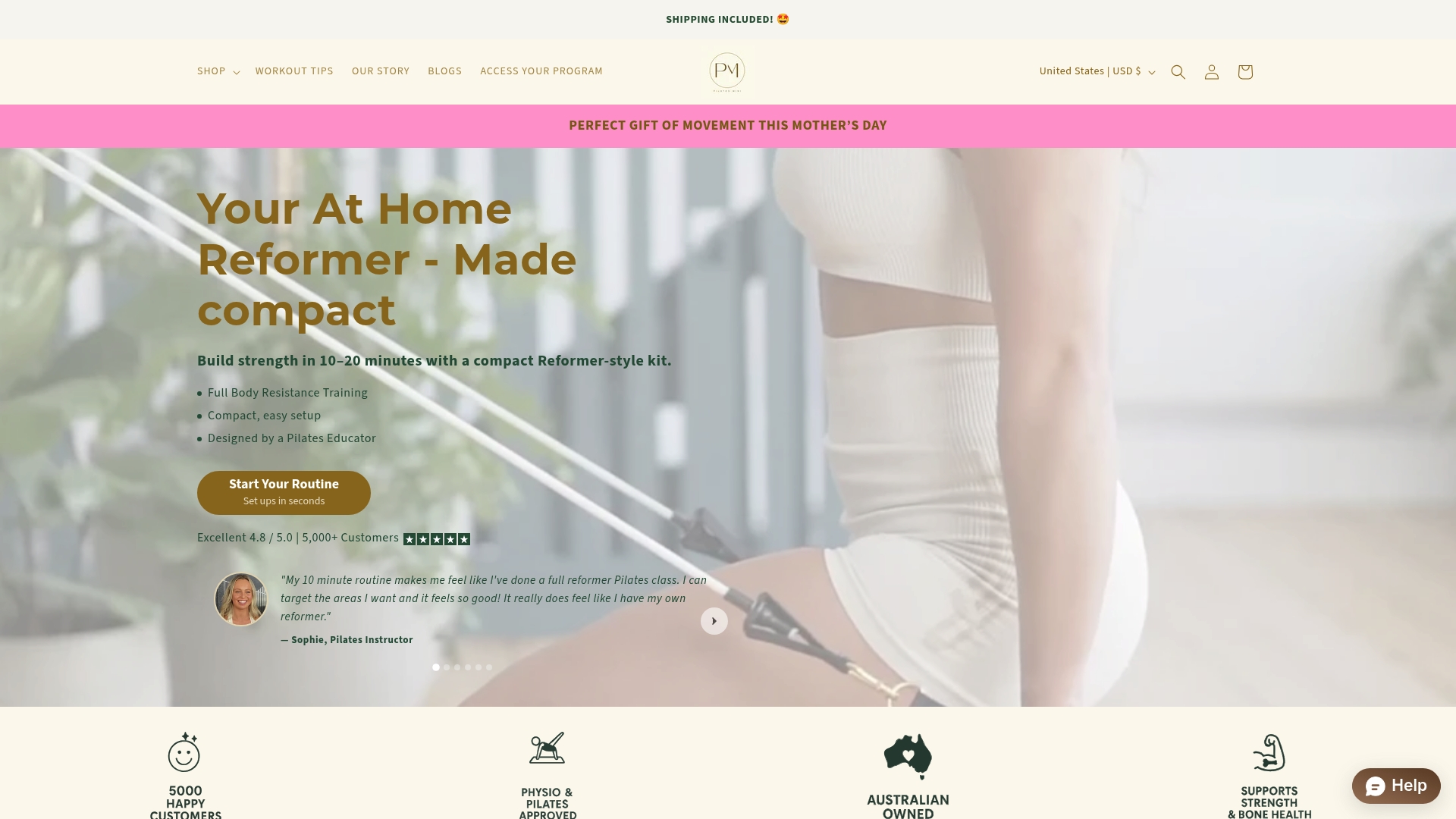
The Pilates Mini reformer kit is built specifically for short, focused home sessions. It includes resistance bands, straps, and a guided workout plan, all in a compact tote bag that fits in a closet or carry-on. No studio. No bulky machine. Just the tools to make your 20-minute Pilates routine more effective, starting today.
Frequently asked questions
Can a 20-minute Pilates workout strengthen my core effectively?
Yes. A 20-minute Pilates session targets deep core muscles through slow, controlled movements, and even 10-minute sessions can build core strength when performed with proper engagement and control.
Do I need equipment to do 20-minute Pilates at home?
No bulky equipment is needed. Standard 20-minute plans use bodyweight throughout, with optional light dumbbells or a mat added for comfort and variety.
How often should I do 20-minute Pilates workouts for best results?
Two to three sessions per week is the most effective frequency. Short, structured sessions repeated consistently over weeks produce better strength and flexibility gains than infrequent longer workouts.
What should I focus on during a 20-minute Pilates session?
Focus on slow, precise movement with consistent core engagement. Pilates builds strength through mind-muscle connection and controlled form, not speed or high repetitions.