
What is Pilates for special populations: a guide to accessible fitness
PHOEBE COLE
Pilates has a reputation problem. Many people assume it belongs exclusively to young, flexible, able-bodied individuals doing advanced moves on studio equipment. That image keeps a lot of people away. But what is Pilates for special populations? It is a thoughtfully adapted approach to movement that serves people with chronic pain, mobility limitations, disabilities, post-surgical recovery needs, and age-related changes. Nearly 12 million Americans practiced Pilates in 2023, including many managing joint pain or restricted mobility. This article breaks down how Pilates works for diverse health needs and how to practice it safely at home or while traveling.
Table of Contents
- Understanding Pilates for special populations
- Benefits of Pilates for individuals with limited mobility and health concerns
- Safe Pilates adaptations and modifications for special populations
- Practical Pilates techniques for home and travel settings
- Comparison of Pilates formats for special populations
- Why Pilates for special populations deserves more attention
- Explore Pilates Mini solutions for accessible Pilates at home and travel
- Frequently asked questions
Key Takeaways
| Point | Details |
|---|---|
| Pilates is adaptable | Pilates uses core principles that allow safe modifications for special populations with mobility or health challenges. |
| Chair Pilates benefits | Chair-based Pilates effectively improves strength, flexibility, and balance without requiring floor exercises. |
| Avoid risky movements | Certain Pilates exercises like spinal flexion should be avoided in conditions like osteoporosis to prevent injury. |
| Accessible equipment | Many Pilates exercises can be performed at home or while traveling with minimal equipment like a sturdy chair or wall support. |
| Consistent practice | Regular Pilates sessions two to three times per week offer sustained improvements in mobility, posture, and confidence. |
Understanding Pilates for special populations
Pilates is a low-impact movement system built around core strength, breathing, precision, and controlled motion. Those principles are not just philosophical. They are practical tools for designing safe workouts around almost any physical limitation.
The phrase “special populations” in fitness refers to groups who need modified exercise programming due to age, injury, chronic illness, disability, or post-surgical recovery. That includes seniors, people with osteoporosis, those managing multiple sclerosis or Parkinson’s disease, individuals recovering from joint replacement, and many others. Special populations fitness is not a niche. It describes a significant share of the adult population.
What makes Pilates a strong match for these groups is its built-in adaptability. Core Pilates principles, including breath, control, and precision, allow instructors and self-directed practitioners to scale every movement to individual ability. Nothing is fixed. Every exercise can be made smaller, slower, or supported.
Key features that make Pilates accessible for special populations include:
- Low-impact movement that protects joints while still building strength
- Core stabilization focus that improves posture and reduces compensatory movement patterns
- Scalable resistance using bands, straps, or bodyweight to match current ability
- Chair and wall variations that eliminate the need for floor work entirely
- Breathing techniques that regulate effort and prevent blood pressure spikes
A home Pilates mini reformer kit adds another layer of adaptability, offering spring-based resistance that can be dialed up or down to match a wide range of ability levels without requiring a full studio setup. You can also find guidance on setting up your Pilates Mini kit at home with minimal space.
Benefits of Pilates for individuals with limited mobility and health concerns
Understanding these specific benefits clarifies why Pilates is an effective option for special populations.
The benefits of Pilates for seniors and individuals with health limitations go well beyond flexibility. Research backs up several areas where adapted Pilates makes a measurable difference.
Pilates improves posture, maintains bone density, reduces back pain, supports cognitive health, and provides a low-impact option for people managing joint pain. These are not minor gains. For someone with osteoporosis, better posture and bone density directly affect fracture risk. For someone managing chronic pain, reduced back pain changes daily quality of life.
Balance is another critical benefit. Fall prevention is one of the most pressing concerns in older adult health, and Pilates directly addresses the muscular control and proprioception (the body’s sense of its own position in space) that prevent falls. Chair-based Pilates improves muscle endurance, flexibility, and balance in postmenopausal women, with measurable reductions in fall risk. The same benefits apply broadly across adults with limited mobility.
“Chair Pilates removes the barrier of floor mobility entirely while still delivering the core strengthening, balance training, and flexibility work that make Pilates effective for rehabilitation and aging populations.”
The benefits of Pilates for chronic pain relief deserve specific mention. Gentle, controlled movement activates deep stabilizing muscles without loading painful joints. This is the opposite of high-impact exercise, which often aggravates pain. Regular Pilates practice also supports immune health and mental well-being by reducing the physical stress load on the body.
You can find practical Pilates workout tips covering modifications that align with these benefits, especially useful if you are working independently at home.
Key benefits for special populations include:
- Reduced chronic back and joint pain through core stabilization
- Improved posture and spinal alignment, particularly valuable for osteoporosis
- Enhanced balance and coordination, lowering fall risk
- Increased muscle endurance without joint strain
- Cognitive and mental health support through focused, mindful movement
- Greater functional independence in daily activities
Safe Pilates adaptations and modifications for special populations
Knowing the benefits is only part of the picture. Next, learn how Pilates safely adapts to various health needs.
Pilates modifications for injuries and medical conditions are not afterthoughts. They are central to how the method works for special populations. A few specific conditions require specific adjustments.
Osteoporosis. People with osteoporosis should avoid spinal flexion exercises, such as roll-ups or forward curl variations, because these movements load the vertebrae in ways that increase fracture risk. Instead, the focus shifts to gentle spinal extension, neutral spine positions, and balance training. Working with a certified instructor experienced in osteoporosis is strongly recommended at first.
Post-joint replacement. Pilates can begin 6 to 12 weeks after hip or knee replacement with medical clearance, but range of motion limits must be respected throughout. Movements that cross the midline, rotate the hip beyond its new safe range, or place excessive load on the new joint need to be avoided or modified. Chair Pilates is often the safest starting point after clearance.
Neurological conditions. For conditions like Parkinson’s disease or multiple sclerosis, adaptive Pilates exercises focus on coordination, balance, and controlled breathing. These directly address the motor and stability challenges these conditions create.
Here is a step-by-step approach to starting adaptive Pilates safely:
- Get medical clearance from your doctor or specialist before beginning
- Identify which movements to avoid based on your specific condition
- Start with chair Pilates or wall-supported exercises for the first 2 to 4 weeks
- Focus on breathing and awareness before adding resistance or range
- Use props like pillows, straps, and folded blankets to support proper alignment
- Progress intensity only when current exercises feel controlled and comfortable
- Reassess with your healthcare provider every 4 to 6 weeks during recovery
Pro Tip: When practicing at home, use a folded towel under your sit bones during seated exercises. This small adjustment tilts the pelvis slightly forward, makes it easier to maintain a neutral spine, and reduces lower back strain significantly.
A complete Pilates Mini starter kit includes resistance bands and straps that support exactly these kinds of modifications, giving you control over resistance and support without needing a full studio reformer.
Practical Pilates techniques for home and travel settings
With safety and adaptations in mind, here are concrete Pilates exercises you can try at home or while traveling.
The good news is that effective adaptive Pilates requires very little equipment. Chair Pilates with pelvic tilts and seated marches can start with just a sturdy, armless chair and 5 to 10 minutes daily. Consistency matters far more than duration at first.
Here is a practical breakdown of accessible Pilates moves by setting:
| Exercise | Setting | Equipment needed | Benefit |
|---|---|---|---|
| Seated pelvic tilts | Home or travel | Sturdy chair | Lumbar awareness, core activation |
| Seated leg lifts | Home or travel | Chair | Hip flexor strength, balance |
| Wall angels | Hotel room or home | Wall | Shoulder mobility, posture |
| Seated spine twist | Home or travel | Chair | Spinal mobility, waist strength |
| Supine knee folds | Home with mat | Exercise mat | Core stability, hip control |
| Resistance band rows | Home or travel | Resistance band | Upper back strength, posture |
Wall-supported exercises are particularly valuable for travelers because they replicate some of the support and feedback that reformer equipment provides. Pressing your back against a wall during standing exercises prevents the compensatory movement patterns that often develop when muscles are weak or fatigued.
Breathing is a technique, not just a cue. In Pilates, lateral thoracic breathing (expanding the ribcage sideways rather than lifting the chest) keeps the core engaged while allowing full lung expansion. Practicing this breathing pattern before any exercise session stabilizes blood pressure and prepares the nervous system for controlled movement.
Key practical guidelines for home and travel Pilates:
- Start each session with 5 minutes of seated breathing to activate core awareness
- Keep sessions short (10 to 20 minutes) and consistent rather than long and sporadic
- Use a chair back or wall for balance support during standing work
- Keep a resistance band in your travel bag as a compact, versatile tool
- Stop any exercise that causes sharp pain or dizziness immediately
Pro Tip: Before adding any resistance, practice the movement slowly without it first. If the form breaks down, the movement is not yet ready for load. This single rule prevents most home Pilates injuries.
Browse the Pilates Mini essentials collection for compact tools including resistance bands and straps that travel easily and work for chair and mat variations alike.
Comparison of Pilates formats for special populations
Now that you know specific exercises, consider which Pilates format might best fit your circumstances through this comparison.
Choosing a format is not just about preference. It is a practical decision based on your current mobility, health status, and available space.
| Format | Equipment | Floor work required | Best for | Limitations |
|---|---|---|---|---|
| Mat Pilates | Mat only | Yes | Mild limitations, home use | Requires floor mobility |
| Reformer Pilates | Reformer machine | No (lying or seated) | Balance issues, varied resistance | Cost, space, access |
| Chair Pilates | Sturdy chair | No | Severe mobility limits, post-surgery | Limited exercise variety |
| Portable Reformer Pilates Mini | Compact kit | Optional | Home and travel, progressive recovery | Requires setup familiarity |
Reformer Pilates offers adjustable resistance and seated support that works well for people managing balance issues, while chair Pilates removes floor work entirely for those who cannot get up and down safely. The portable reformer option bridges both worlds.
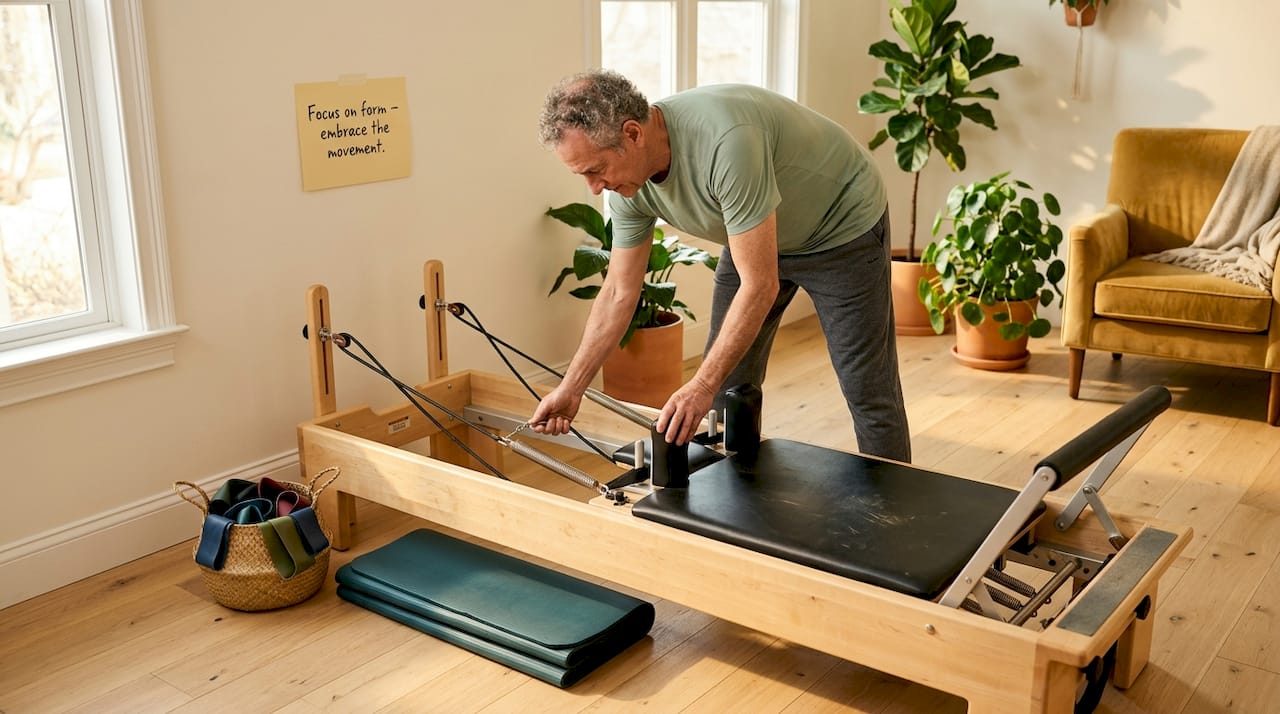
Pro Tip: If you are recovering from surgery or managing a chronic condition, start with chair Pilates for the first four to six weeks, then transition to a portable reformer as your confidence and strength build. This progression prevents the discouragement that comes from attempting too much too soon.
The Pilates Mini portable reformer is designed to fit this progressive model, offering reformer-style resistance in a format that works at home or while traveling, without the footprint of traditional studio equipment.

Why Pilates for special populations deserves more attention
Most fitness conversations center on people who are already relatively healthy and mobile. Special populations fitness gets treated as an edge case. That framing is wrong, and it matters.
Pilates is not just a safe exercise option for people with health limitations. It is one of the only movement systems built around principles that specifically support rehabilitation, neuromuscular re-education (retraining how the brain and muscles communicate after injury or illness), and confidence in movement. Most gym-based fitness programs are not designed with these goals in mind.
Pilates empowers special populations by promoting confidence, autonomy, and neuromuscular re-education that standard fitness programs consistently overlook. This is the part that rarely gets discussed. Fear of movement is a real and significant barrier for people recovering from injury, managing chronic pain, or dealing with neurological conditions. Pilates, practiced with appropriate modifications, rebuilds the relationship between body and movement. That is not something a general strength program reliably delivers.
Healthcare providers often recommend physical therapy and then leave a gap. What comes after discharge? For many people, the answer has been nothing. Adapted Pilates can fill that gap in a way that is sustainable, accessible, and genuinely enjoyable. It does not require a gym membership, a full studio reformer, or supervision once the basics are understood.
The broader opportunity here is collaboration between fitness educators, physical therapists, and healthcare providers. When practitioners understand how to adapt Pilates for rehabilitation and special needs, they provide something genuinely rare: a movement practice that does not exclude people based on what their body cannot do. Learn more about the thinking behind this approach at the Pilates Mini story page.
Explore Pilates Mini solutions for accessible Pilates at home and travel
If you are managing a health condition, recovering from surgery, or working around limited mobility, having the right tools makes a real difference in what you can actually practice consistently.
The Pilates Mini portable reformer is built for exactly this kind of use. Compact, easy to set up, and compatible with chair-based and mat variations, it brings reformer-style resistance to your home or hotel room without bulk. The complete Pilates Mini starter kit includes resistance bands, straps, a tote bag, and guided workout plans that help you build a safe, progressive routine from day one. For additional support and comfort, the Pilates Mini essentials collection adds props that work alongside chair and mat modifications for special populations.
Frequently asked questions (FAQs)
Q: Is Pilates safe for people with osteoporosis?
A: Yes, with the right modifications. Osteoporosis-safe Pilates avoids spinal flexion exercises to prevent fractures and focuses instead on neutral spine positions, gentle extension, and balance training.
Q: Can chair Pilates improve mobility for individuals with limited movement?
A: Yes. Chair-based Pilates enhances muscle endurance, flexibility, and balance in people with mobility limitations, making it a well-supported and safe exercise alternative that requires no floor work.
Q: When can someone start Pilates after hip or knee replacement surgery?
A: Modified Pilates can begin 6 to 12 weeks after hip or knee replacement surgery, provided you have medical clearance and adhere to your surgeon’s range of motion restrictions throughout each session.
Q: Do I need special equipment to do Pilates at home or while traveling?
A: No special equipment is required to start. Chair Pilates needs only a sturdy chair, and wall-supported exercises replicate equipment feedback for travelers, making Pilates genuinely accessible anywhere.
Q: How often should special populations practice Pilates for benefits?
A: Practicing 2 to 3 sessions weekly, each lasting 30 to 60 minutes, provides meaningful improvements in strength, balance, and posture for older adults and those with health limitations.