
Pilates principles that make every workout more effective
PHOEBE COLEMost people think Pilates is a niche workout for dancers or rehab patients. That’s a mistake. The principles behind Pilates, including control, precision, and breath, are the same foundations that make strength training, yoga, and even basic home workouts actually work. Once you understand them, you’ll see them everywhere.
Table of Contents
- What are the core Pilates principles?
- How Pilates principles support diverse fitness methods
- Why safe programming matters more than principles alone
- Applying Pilates principles at home with portable equipment
- The uncomfortable truth: Why Pilates principles alone won’t guarantee gains
- Elevate your home practice with Pilates Mini kits
- Frequently asked questions
Key Takeaways
| Point | Details |
|---|---|
| Principles guide effective movement | Pilates principles lay a foundation for safer, smarter workouts across all fitness methods. |
| Programming trumps principles alone | Results depend on individualized progression and safe routines—not just principles. |
| Portable tools enable home success | Compact Pilates equipment makes it easier to apply principles and benefit from home workouts. |
| Evidence highlights nuance | Research shows Pilates improves pain and quality of life, with varying effects on strength. |
What are the core Pilates principles?
Pilates principles are not abstract ideas. They are practical movement guidelines that shape how you perform every rep, every stretch, and every posture correction. Joseph Pilates called his method “Contrology,” which tells you a lot about the priority he placed on intentional, deliberate movement rather than volume or speed.
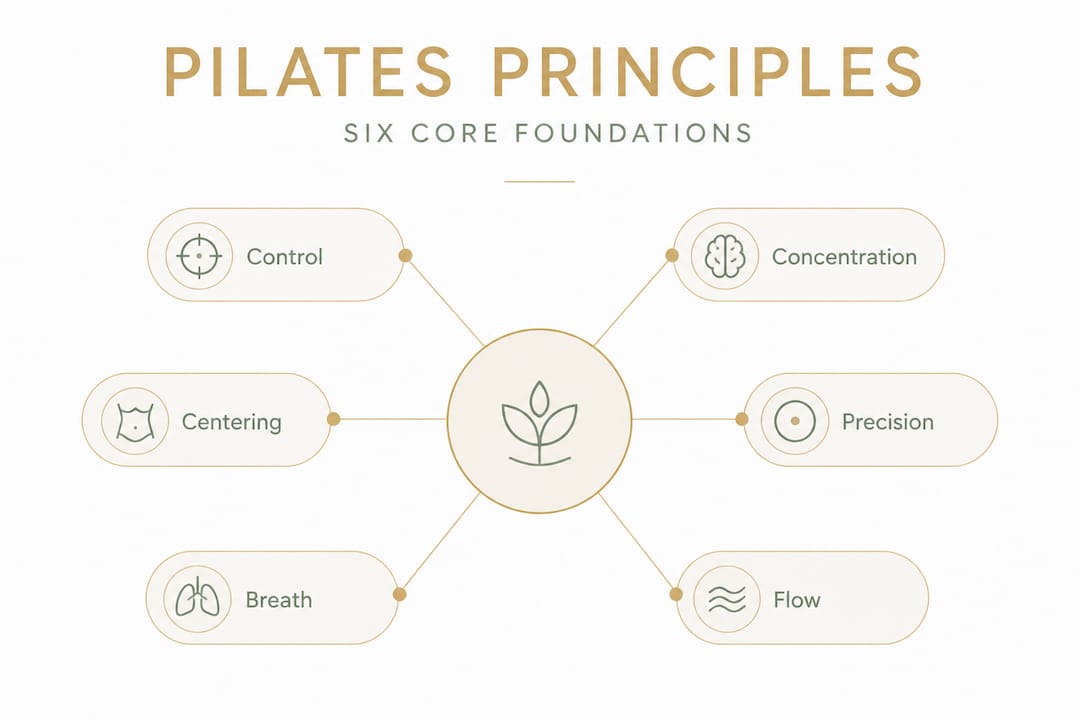
Here are the six core principles and what they mean in practice:
- Control: Every movement is performed with full muscular awareness. Nothing is thrown or dropped. You move with intention, which reduces injury risk and increases muscle activation.
- Concentration: You focus on the muscles being worked, not the clock. This mind-muscle connection is backed by research and improves movement quality significantly.
- Centering: All movement originates from the core, which includes the deep abdominals, pelvic floor, and lower back muscles. Centering stabilizes the spine before limbs move.
- Precision: Quality beats quantity. One perfectly executed movement does more for your body than ten sloppy ones.
- Breath: Breathing is coordinated with movement to support the core, reduce tension, and maintain rhythm. Exhale on exertion is the general rule.
- Flow: Movements connect smoothly rather than stopping and starting. This builds coordination and keeps the body working as a system.
These principles are not optional extras. They are the operating system. Research shows that Pilates improves outcomes like pain and disability, though effect sizes and quality of evidence vary depending on the population and program design. That variation matters, and we’ll get to it.
| Principle | Core function | Applies to |
|---|---|---|
| Control | Reduces injury, improves activation | All movement types |
| Concentration | Mind-muscle connection | Strength, rehab, flexibility |
| Centering | Spinal stability | All exercises |
| Precision | Movement quality | Technique-focused training |
| Breath | Core support, rhythm | All movement |
| Flow | Coordination, continuity | Circuits, routines |
For practical home workout tips, applying even two or three of these principles consistently will shift the quality of your sessions noticeably. You don’t need a studio or a reformer to start.
How Pilates principles support diverse fitness methods
With these principles identified, let’s see how they show up in everyday fitness approaches beyond Pilates.
Pilates principles are not owned by Pilates. Yoga instructors cue breath and flow constantly. Physical therapists use centering and precision when rehabilitating knee injuries. Strength coaches emphasize control and concentration for compound lifts. The principles have always been cross-disciplinary. They just weren’t always labeled this way.
Here’s how to apply them across different workout formats:
- Strength training: Before each set, take a breath, brace your core (centering), and move the weight with full control on both the lift and the lower. This alone improves muscle engagement and reduces joint stress.
- Yoga: Coordinate breath with each transition. Focus on precision in alignment rather than depth of stretch. Flow between poses rather than holding static positions in isolation.
- Bodyweight home workouts: Apply concentration to every movement. During a squat, think about the glutes and the foot contact with the floor. Slow down the tempo to add control without adding weight.
- Flexibility routines: Use breath to release tension. Exhale into a stretch rather than forcing range. Centering keeps the spine neutral so you stretch the target muscle rather than compensating elsewhere.
- Resistance band training: Precision is especially important here. Bands create variable resistance, so sloppy form at the end range is common. Control the return phase as carefully as the working phase.
| Workout type | Most relevant principles | Common mistake without them |
|---|---|---|
| Strength training | Control, centering | Compensating with momentum |
| Yoga | Breath, flow, precision | Forcing depth over alignment |
| Bodyweight circuits | Concentration, control | Speed over form |
| Flexibility work | Breath, centering | Overstretching, spinal flexion |
| Band resistance | Precision, control | Losing tension on return |
It’s worth being clear about what the research actually says. Pilates effects on strength were small and overall evidence certainty was very low, with physical function effects unclear due to limited data. That’s not a reason to dismiss Pilates principles. It’s a reason to pair them with smart programming rather than treating them as a complete solution on their own.
Pro Tip: If you’re a beginner, start with just two principles per session. Pick control and breath. Once those feel automatic, layer in precision and centering. Trying to apply all six at once leads to overthinking rather than better movement.
A good Pilates starter kit gives you the tools to practice these principles at home without needing a full reformer setup. Resistance bands and straps are particularly useful for applying control and precision because they make you slow down and feel the resistance throughout the full range of motion. You can also explore portable Pilates essentials for compact options that travel well.
Why safe programming matters more than principles alone
With Pilates principles threaded throughout fitness methods, it’s crucial to examine whether simply having principles is enough for results.
The short answer is no. Principles are a framework, not a program. A framework without structure is just intention. You can know all six principles and still design a home workout that’s too advanced, too repetitive, or missing the progression needed to actually improve.
Here’s what safe, effective home programming actually requires:
- Progression: Workouts must get harder over time. That means adding resistance, increasing range of motion, or reducing rest periods. Without progression, the body adapts and stops changing.
- Individualized cues: The same exercise cue doesn’t work for everyone. “Tuck your pelvis” helps some people find neutral spine. For others, it creates more tension. Cues need to match the person.
- Recovery built in: Rest is not optional. Muscles repair and strengthen during recovery, not during the workout itself. A good program schedules rest days and lighter sessions.
- Exercise selection matched to ability: Starting with advanced movements because they look impressive is a fast route to frustration or injury. Beginners need foundational patterns first.
- Feedback loops: Without a mirror, a coach, or video review, form errors compound over time. Home workouts benefit from periodic check-ins, even if just recording yourself on a phone.
“Principles don’t automatically prevent variability in programming quality; strong cueing is necessary but not sufficient without appropriate progression and individualized modifications.”
This matters especially for home workouts. In a studio, an instructor adjusts your form in real time. At home, you’re on your own. That’s why the programming around the principles carries as much weight as the principles themselves.
A well-designed Pilates mini reformer kit includes guided workout plans precisely because equipment alone isn’t enough. The plan tells you how to progress, which exercises to pair, and how to modify based on your level. That’s the programming layer that makes the principles actually deliver results. Learn more about our approach to Pilates and how we’ve built that structure into every kit.
Applying Pilates principles at home with portable equipment
Understanding the importance of safe programming, let’s explore how you can integrate Pilates principles into your home routine using portable tools.

Portable equipment, particularly resistance bands and straps, is well suited to Pilates principles because it creates feedback. When you lose control of a band, you feel it immediately. That tactile feedback reinforces the principles of control and precision better than bodyweight alone in many cases.
Here’s a beginner-friendly numbered routine that applies all six principles using compact equipment:
- Breathing warm-up (2 minutes): Lie on your back, knees bent. Inhale to expand the ribcage laterally. Exhale fully, drawing the lower belly in. This activates the deep core before any movement begins. Principle: breath and centering.
- Banded glute bridge (10 reps): Place a resistance band just above the knees. Lift hips slowly on a 2-count, hold at the top for 1 second, lower on a 3-count. Focus on pressing the knees outward against the band throughout. Principles: control, concentration, precision.
- Standing band row (12 reps each side): Anchor the band at door height. Pull the elbow back slowly, pause, return with control. Keep the shoulder blade moving, not just the arm. Principles: control, centering, flow.
- Side-lying leg series (8 reps each direction): Lie on your side, stack hips, and lift the top leg with control. Small, precise movements. No hip rocking. Principles: centering, precision, concentration.
- Seated forward stretch with band (30 seconds): Sit tall, loop the band around your feet, hold both ends. Exhale and hinge forward from the hips, not the waist. Principles: breath, precision, flow.
- Cool-down breathing (2 minutes): Return to the breathing warm-up pattern. Notice how the body feels compared to the start.
This routine takes about 20 minutes. It’s not flashy. But it applies all six principles in a logical sequence that moves from activation to strength to flexibility to recovery.
Research shows that Pilates improves quality of life with an SMD of 2.10 versus control, but these gains must be paired with appropriate progression to be sustained. That means this routine needs to evolve. Add resistance, increase reps, or slow the tempo as your ability grows.
Pro Tip: Consistency matters more than intensity at the start. Three sessions per week using this routine will produce more noticeable results than one intense session followed by five days off.
For setup guidance, the Pilates kit setup page walks through exactly how to anchor your equipment safely at home. And if you’re just getting started, the portable Pilates reformer overview shows how the full kit comes together.
The uncomfortable truth: Why Pilates principles alone won’t guarantee gains
Most fitness content stops at the principles. Learn the six, apply them, get results. It’s a clean story. But it’s not the full picture.
The myth persists because principles feel sufficient. They’re specific, they’re named, and they sound like a system. But a system without progression is just a habit. And habits without challenge produce maintenance, not improvement.
We’ve seen this pattern repeatedly. Someone starts applying Pilates principles to their home workouts. The first few weeks feel transformative because they’re moving with more awareness than before. Then progress stalls. The principles haven’t changed. The programming hasn’t changed either. That’s the problem.
Real results come from blending principles with smart progression. That means the principles are your constant and the programming is your variable. Every few weeks, something in the program should shift. More resistance, slower tempo, more complex movement patterns, shorter rest. The principles stay the same. The challenge level doesn’t.
For newcomers, the most practical advice is this: don’t try to master all six principles before you start. Pick control and breath. Build those into every movement until they’re automatic. Then add precision. Then centering. Layer the principles the way you layer fitness itself, gradually and with intention.
For more advanced users, the risk is different. You already know the principles. The temptation is to add complexity, more exercises, more equipment, more variety. But the tools for effective home workouts that produce the best long-term results are simple ones used consistently with excellent form. Complexity is not the same as progress.
The uncomfortable truth is that knowing the principles is easy. Applying them consistently, progressing them intelligently, and modifying them based on how your body responds on any given day, that’s the actual work.
Elevate your home practice with Pilates Mini kits
Pilates principles are clear. Safe programming is essential. Now the question is what tools support both without requiring a dedicated studio or expensive equipment.
Pilates Mini kits are built for exactly this. Each kit includes resistance bands, straps, a tote bag, and guided workout plans that apply Pilates principles with built-in progression. No bulky reformer needed. The complete Pilates Mini starter kit gives beginners a structured entry point, while the home Pilates Mini reformer kit adds more resistance options for those ready to progress. Compact enough for a small apartment or a carry-on bag. Designed to make the principles practical, not theoretical.
Frequently Asked Questions (FAQs)
Q: What are the six core Pilates principles?
A: The six core principles are control, concentration, centering, precision, breath, and flow. Each one supports safe and effective movement across all fitness types.
Q: Can Pilates principles improve strength and flexibility with portable equipment?
A: Yes, Pilates principles support strength and flexibility gains in home workouts, but effects on strength were small with very low evidence certainty, meaning programming quality and progression are essential to see real results.
Q: Is following Pilates principles alone enough for safe workouts?
A: No. Principles must be paired with individualized cues, progression, and structured programming. Programming quality varies even when principles are present, and strong cueing alone is not sufficient without appropriate modifications.
Q: What evidence supports the effectiveness of Pilates principles?
A: Meta-analyses show Pilates reduces pain and disability with SMDs of 1.41 and 0.83 respectively, and improves quality of life with an SMD of 2.10, though strength effects were small and evidence certainty was very low.