
Reformer Alternative Equipment for Effective Small-Space Pilates
PHOEBE COLEYou don’t need a $5,000 studio reformer taking up half your living room to get real Pilates results. The fitness industry has long pushed the idea that authentic reformer training requires that full sliding carriage setup, but home fitness has changed fast. Portable systems, clever prop combinations, and compact resistance tools now replicate most of what a studio reformer delivers, without the price tag or the footprint. This guide breaks down every category of reformer alternative, explains how resistance mechanics actually work, and helps you match the right equipment to your specific space and goals.
Table of Contents
- What qualifies as reformer alternative equipment?
- Comparing resistance mechanics: Springs vs bands, cords, and props
- Top space-saving reformer alternatives for home
- Accessory-based solutions: Mat, props, and Pilates bars
- How to choose the right reformer alternative for your space and goals
- Our take: What most home Pilates shoppers miss when seeking reformer alternatives
- Ready to find your perfect reformer alternative?
- Frequently asked questions
Key Takeaways
| Point | Details |
|---|---|
| Compact solutions | Portable reformer alternatives enable challenging Pilates workouts in small home spaces. |
| Adjustable resistance matters | Choosing equipment with progression options delivers better long-term results. |
| Accessory systems | Mats, props, and bars provide affordable, versatile strength and flexibility training. |
| Space planning | Selecting close-to-ground and foldable devices enhances safety and consistency. |
| Function over branding | Prioritizing mechanics and adjustability beats marketing hype for effective home workouts. |
What qualifies as reformer alternative equipment?
The term gets used loosely in fitness marketing, so it helps to start with a clear definition. Reformer alternative equipment generally refers to Pilates equipment that provides reformer-like training, including spring or elastic resistance, straps, and footwork, in a smaller footprint or at a lower cost, rather than requiring a full studio-style sliding carriage reformer.
In practical terms, that covers a wide range of tools. Some are purpose-built compact machines. Others are simple prop and band systems. What they all share is the ability to load the body in Pilates-specific ways, working the deep stabilizers, building functional strength, and improving mobility without a full reformer carriage.
The main categories home users work with include:
- Portable reformer kits that use resistance bands and straps anchored to a doorway or floor
- Pilates chairs with spring-loaded pedals that build leg and core strength
- Barrels and towers that support spinal mobility and articulation work
- Mat plus prop systems using foam rollers, Pilates rings, and resistance bands
“Reformer alternative equipment generally refers to Pilates equipment that provides reformer-like training (spring/elastic resistance, straps/footwork) in a smaller footprint or lower cost, rather than a full studio-style sliding carriage reformer.”
Choosing a portable reformer kit means understanding which category fits your actual movement goals. Someone focused on leg strength and hip stability needs different equipment than someone working on spinal mobility and flexibility. The category you start with shapes everything downstream, including which exercises you can do and how quickly you can progress.
For structured routines that work with most alternative systems, a 7-day Pilates guide gives you a repeatable starting framework regardless of what equipment you own. Following home workout tips built around alternative equipment also prevents the common mistake of using the wrong setup for your specific goals.
Comparing resistance mechanics: Springs vs bands, cords, and props
This is where most shoppers get tripped up. The marketing language around reformer alternatives often borrows studio terminology without explaining what’s actually different under the hood.
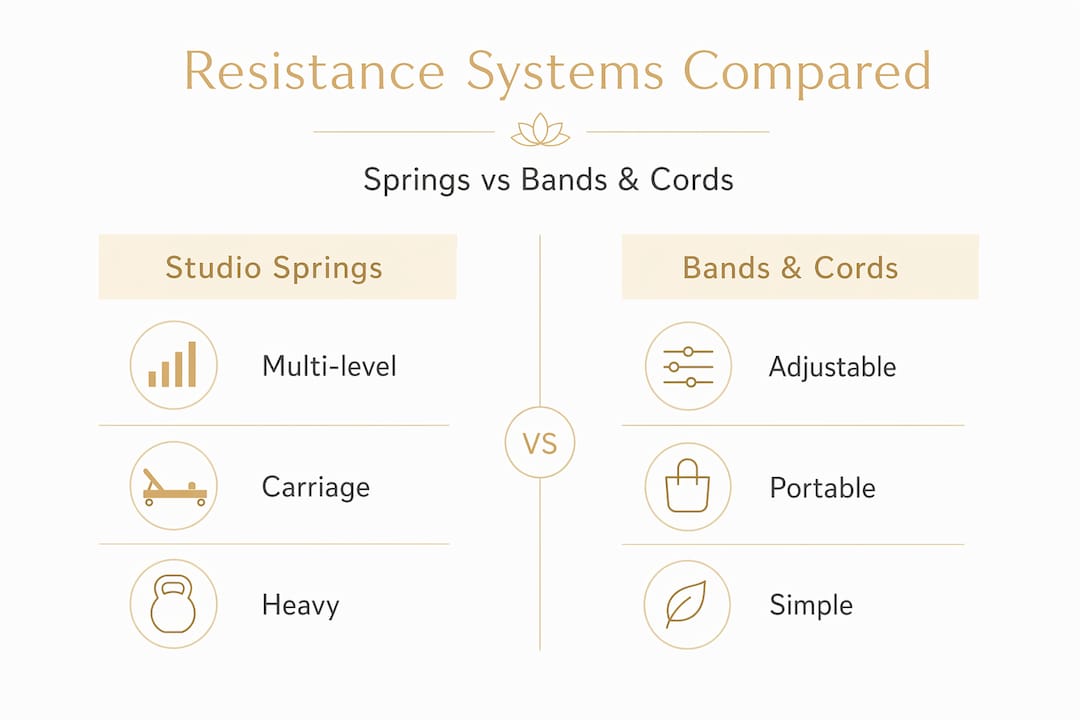
Traditional studio reformers use multiple calibrated springs attached to a sliding carriage. You can stack or remove springs to adjust tension precisely. The carriage itself moves along rails, creating resistance both during the push phase and the return. That two-directional loading is what makes reformer training so effective for building eccentric strength and control.
Compact alternatives typically use cords, bands, or simplified resistance systems rather than multi-spring adjustable-tension carriage mechanics. That distinction matters because it changes how resistance is loaded and adjusted.

Here’s a side-by-side look at how resistance types compare:
| Feature | Studio reformer | Band/cord system | Compact spring apparatus |
|---|---|---|---|
| Resistance source | Multi-spring calibrated | Elastic bands/cords | Simplified spring(s) |
| Adjustability | High, multiple springs | Moderate, band swaps | Low to moderate |
| Carriage travel | Yes, bidirectional | No | Limited |
| Footprint | Large (about 90 inches) | Minimal | Small to medium |
| Price range | $2,000 to $10,000+ | $50 to $300 | $200 to $800 |
| Portability | None | High | Low to moderate |
The key takeaway from this table is that band and cord systems sacrifice carriage mechanics but gain portability and affordability. Simplified spring apparatus sits in the middle.
Pro Tip: When shopping alternatives, look for at least three distinct resistance levels you can adjust without buying new equipment. A single fixed-resistance band or spring will limit your progression faster than any other factor.
The Pilates Mini Reformer Kit uses a band and strap system that anchors for doorway use, giving you adjustable pull and push resistance for common reformer exercises like footwork, leg circles, and row patterns. For a fuller accessory bundle, the Complete Pilates Starter Kit adds guided programs that help you work around the absence of carriage travel. Browsing the Pilates Mini Essentials collection also shows you how different resistance tools layer together for a more complete home system.
Top space-saving reformer alternatives for home
Now that you understand mechanics, here are the alternatives that actually perform well in real home spaces, ranked by practical usability.
According to a smart Pilates equipment guide, the most common reformer alternative categories for limited spaces include Pilates chairs with spring-loaded pedals, barrels and tower-style spring units, and compact portable systems.
- Portable band and strap systems. These anchor to a door frame or wall mount. Setup takes under two minutes. Storage fits in a tote bag. They cover footwork, pulling, and pressing patterns effectively.
- Pilates chairs (Wunda-style). Spring-loaded pedal resistance trains single-leg pressing, step-ups, and seated hip work. Folds flat in most designs. Takes about 24 inches of floor space when in use.
- Barrel and arc systems. Best for spinal extension, hip opening, and side stretching. Small arc barrels fit under most beds. Limited resistance options but excellent for mobility work.
- Tower or wall unit. Springs mount to a wall bracket. Provides spring resistance closest to a full reformer without the carriage. Requires a fixed wall mount but zero floor footprint.
- Mat plus prop combinations. Rings, foam rollers, sliders, and resistance bands layered over mat work. Covered more in the next section.
Foldable and close-to-ground equipment reduces friction for daily use, which directly affects how consistent you are. The research on exercise adherence consistently points to setup time as a major barrier. If your equipment takes 10 minutes to configure, you’ll use it less often.
Pro Tip: Measure not just the device footprint but the clearance you need around it. A Pilates chair requires about 36 inches of open space around it for safe leg extension and press movements. A doorway setup only needs that 36-inch corridor in front of the door.
Check the doorway setup guide if you’re working with a doorway-anchored system. The Pilates Mini story also gives useful context on how these compact systems were designed specifically around the constraints real home users face.
Accessory-based solutions: Mat, props, and Pilates bars
Accessories often get dismissed as inferior options, but that underestimates what they actually deliver. For specific goals and spaces, they’re the most practical choice available.
Some reformer alternatives are mostly accessory and prop systems, meaning they deliver Pilates-style training but not the complete set of reformer mechanics like carriage travel and multi-tension springs. That’s an honest limitation worth understanding before buying.
But here’s what prop-based systems do well:
- Pilates rings add isometric resistance to mat exercises without any setup time
- Foam rollers challenge balance and core engagement throughout standard sequences
- Resistance bands layer resistance onto mat footwork and bridging exercises
- Pilates bars with attached bands mimic standing and seated pressing patterns
If your goal is flexibility, mobility, and general strength on a budget, mat and prop systems or a Pilates bar can be a more realistic reformer alternative than a compact machine.
“If your goal is flexibility/mobility and general strength on a budget, mat+props or a Pilates bar can be a more realistic ‘reformer alternative’ than a compact machine.”
The honest comparison is this: accessories don’t give you carriage mechanics, and they don’t replicate the dynamic resistance of spring-loaded systems. What they do give you is full body Pilates work, core activation, and flexibility training in literally zero extra storage space. A resistance band and mat can live in a drawer.
Tracking your progress matters more once you shift to accessory-based training, since you won’t have spring settings as an easy reference point. A structured wellness journal helps you log resistance levels, reps, and how movements feel so you can spot actual progression over time.
How to choose the right reformer alternative for your space and goals
With this many options, a clear decision framework helps more than a ranked list. The benchmarks for choosing an alternative typically come down to space and footprint, resistance adjustability, durability, and whether the device supports progression across multiple resistance levels.
Work through these factors in order:
- Space first. Measure your available floor space, ceiling height, and doorway access before looking at any product. This immediately eliminates most options and simplifies your decision.
- Resistance range second. You need at least light, medium, and heavy resistance options to progress over months of training. Single-tension tools plateau fast.
- Durability third. Bands degrade over time, especially with heavy use. Look for latex-free materials with reinforced anchor points if you plan daily sessions.
- Exercise coverage last. Make a list of the Pilates exercises most important to your goals. Match that list to what each system actually supports.
A reformer kit for small spaces covers footwork, pulling, pushing, and stabilization patterns across multiple resistance bands. For a full accessory selection, the essential Pilates accessories collection lets you build a layered system rather than committing to one single piece of equipment up front.
The most common mistake at this stage is buying based on what looks most like a real reformer rather than what fits the space and supports the actual movement goals. Aesthetic similarity to studio equipment does not translate to better results.
Our take: What most home Pilates shoppers miss when seeking reformer alternatives
Most people shopping for reformer alternatives focus on features and branding. They want something that looks like a reformer, is described using reformer language, and comes with a recognizable name. That logic leads to poor purchasing decisions more often than not.
What actually matters is adjustability and friction. Those two factors explain most of the outcome differences between home Pilates users who build consistent strength over months versus those who abandon equipment after six weeks.
Adjustability means your system can grow with you. When the light band becomes easy, you need a medium option. When medium becomes easy, you need heavy. Without that progression ladder, you plateau. A $400 compact machine with fixed resistance will stop working for you faster than a $80 band kit with five interchangeable levels.
Friction means how hard it is to start a session. Studio-quality equipment that takes 15 minutes to set up will get used three times a week at best. Equipment that lives clipped to a doorframe and takes 90 seconds to rig will get used daily. Daily use at moderate intensity beats twice-weekly sessions on perfect equipment every time.
The brands and features that fill Pilates equipment marketing tend to emphasize what looks premium. Real home workout success comes from expert workout tips paired with equipment that removes barriers rather than creating them. Choose the system you will actually use, not the system you think you should want.
Ready to find your perfect reformer alternative?
Portable kits, starter bundles, and essential accessories are available for all space types and fitness goals.

The Complete Pilates Mini Starter Kit includes resistance bands, straps, a tote bag, and guided workout plans, covering everything needed to replicate core reformer movements at home or while traveling. For individual accessories and add-ons that layer onto an existing mat practice, the Pilates Mini Essentials collection lets you build out your setup piece by piece. Both options ship with guided instruction, so setup and first workouts are straightforward from day one.
Frequently asked questions (FAQs)
Q: Do reformer alternatives offer the same workout benefits as traditional reformers?
A: Most alternatives deliver comparable strength and flexibility gains for general fitness goals. However, some alternatives are primarily prop or accessory systems and cannot replicate carriage travel or multi-tension spring mechanics.
Q: What’s the most space-efficient reformer alternative for a studio apartment?
A: Compact portable systems and Pilates bars require the least storage and fastest setup. According to a Pilates equipment buying guide, chairs, tower units, and compact portable systems are the leading options for limited spaces.
Q: How do I choose between a mat/prop system and a portable reformer?
A: Choose mat and props for flexibility, mobility, and general strength on a tighter budget. A portable reformer alternative makes more sense when adjustable resistance and measurable progression are the primary goals.
Q: Are foldable Pilates equipment pieces durable enough for daily use?
A: Durability varies by product, but the key factors are material quality and anchor construction. Prioritizing adjustable resistance and reinforced straps, as outlined in equipment benchmarks, gives you the best shot at long-term reliability.
Q: Can reformer alternatives deliver studio-level guided movement?
A: Some compact systems include guided programs, but most use simplified resistance mechanics. A portability-focused alternative typically relies on bands and straps with fewer adjustment points than a full studio reformer, meaning movement guidance depends more on your program than the equipment itself.