
Why online Pilates teaching has grown: A guide
PHOEBE COLE
Pilates was the most-booked workout globally for the third consecutive year, with reservations up 66% year over year. That number surprises people. Even more surprising is how much of that growth happened online. Why online Pilates teaching has grown so fast is a question worth answering clearly, because the reasons go well beyond pandemic necessity. They reflect real shifts in how people want to exercise, what technology now makes possible, and why Pilates specifically thrives when it moves into a digital format. This article covers each of those drivers in plain terms.
Table of Contents
- The pandemic’s role in accelerating online Pilates growth
- Why Pilates suits the online format better than many workouts
- The evolution from passive videos to interactive two-way coaching
- How hybrid coaching models enhance consistency and member retention
- Practical benefits of online Pilates for health-conscious home exercisers
- Why online Pilates teaching growth is more than a trend: it’s a sustainable fitness evolution
- Explore Pilates Mini: Your portable home Pilates solution
- Frequently asked questions
Key Takeaways
| Point | Details |
|---|---|
| Surge driven by pandemic | Pilates’ growth online was accelerated by the pandemic aligning with consumer needs for accessible fitness. |
| Two-way coaching advantage | Real-time instructor feedback in online classes ensures safety and effectiveness unmatched by passive videos. |
| Hybrid models boost retention | Combining online and in-studio sessions in one seamless experience helps maintain long-term engagement. |
| Pilates suits home fitness | Minimal equipment, space efficiency, and personalized programming make Pilates ideal for health-conscious home exercisers. |
| Technology powers growth | Advanced scheduling, data insights, and interactive coaching technology transform Pilates into a scalable fitness solution. |

The pandemic’s role in accelerating online Pilates growth
Timing matters in fitness trends. When studios shut down in 2020, most workout formats lost momentum fast. Pilates did not. Its adaptability gave it a rare edge.
“Pilates hit a unique inflection point during the pandemic, allowing it to adapt seamlessly to virtual and in-person formats while other fitness modalities struggled.”
This was not accidental. Pilates is built around body weight, precise movement, and breath. It does not require heavy machines or a large class floor. That made it easier to stream from a living room than, say, a spin studio or a boxing gym.
What changed most was the consumer mindset. People who had never tried Pilates discovered it at home and stayed with it. Studios that had been skeptical of digital offerings built online programs out of necessity and found that retention held. The Pilates growth story since 2020 is largely a story of that mindset shift becoming permanent.
Key factors that made Pilates well suited for pandemic-era adoption:
- No large or specialized equipment required for mat-based work
- Sessions can run in short windows, from 20 to 45 minutes
- Low injury risk made it approachable for first-time online users
- Instructors could teach from home without losing quality
- Class recordings remained useful as on-demand content after the live session
Why Pilates suits the online format better than many workouts
Not every fitness discipline transfers well to a screen. Weightlifting benefits from spotters. Contact sports need proximity. Pilates, by contrast, is built around precision, and precision is something a good camera angle can actually support.
The core of Pilates instruction is form correction. An instructor watching your hip alignment, spinal position, or breath pattern does not need to be in the same room to spot a problem. A well-framed video call gives a trained eye enough information to guide you accurately.
Here are four reasons Pilates adapts to online delivery better than most workouts:
- Form is the product. Pilates outcomes depend on how you move, not how much weight you lift. That means coaching quality drives results, and coaching can happen remotely.
- Space requirements are minimal. A mat and a small amount of floor space is enough for a full session. No reconfiguring a room around a rack or bench.
- Special populations benefit specifically. Research shows Pilates manages pregnancy-related musculoskeletal pain effectively, and online access means those clients get specialized guidance without requiring travel.
- Progression is trackable. Pilates has a clear skill ladder. Instructors can assign progressions between sessions and review them on camera in the next class.
Pro Tip: When joining an online Pilates class, position your camera slightly to the side rather than straight on. A lateral view gives your instructor a much clearer read on your spinal alignment and hip position.
For practical pilates workout tips that carry over directly to online sessions, position, lighting, and equipment setup all affect how well an instructor can coach you remotely.
The evolution from passive videos to interactive two-way coaching
The first wave of online fitness was pre-recorded videos. You pressed play, you followed along, and you hoped you were doing it right. That model has real limits for Pilates because form errors compound over time. Doing a movement incorrectly for six weeks does not build strength. It builds a habit that is harder to fix.
Two-way coaching changed that equation entirely. Live video platforms now allow instructors to watch, stop, cue, and correct in real time. The class is no longer passive.
“Two-way coaching allows instructors to provide real-time form correction, key for Pilates safety and effectiveness, shifting online classes from passive to active coaching.”
This shift matters for three reasons. First, it restores the feedback loop that makes Pilates effective. Second, it increases accountability. Knowing your instructor is watching changes how seriously you approach each rep. Third, it builds the kind of relationship that keeps people coming back.
| Format | Form feedback | Accountability | Personalization |
|---|---|---|---|
| Pre-recorded video | None | Low | None |
| Live group stream | Limited | Moderate | Low |
| Two-way coaching session | Real-time | High | High |
| Hybrid (studio plus online) | Full | High | High |
The data in that table reflects the practical experience of instructors who have tested all four formats. The shift toward two-way sessions is now driving the standard for what clients expect from online Pilates.
Pro Tip: When choosing an online Pilates program, look specifically for live two-way sessions rather than just on-demand libraries. The coaching relationship is where the results actually come from.
A reliable starter kit for home Pilates also helps here. When you have consistent equipment, your instructor can give you repeatable cues tied to what you are working with each session.
What good two-way coaching includes:
- Real-time alignment cues during movement
- Breath coaching specific to the exercise
- Modification options called out live, not just listed in a PDF
- Progress check-ins between sessions to adjust programming
- Instructor visibility into how you respond to different cues over time
How hybrid coaching models enhance consistency and member retention
The rise of virtual pilates classes did not kill studio demand. It created a new problem: how do you serve a client who wants both? Hybrid coaching is the answer the Pilates industry settled on.
Hybrid coaching combines in-studio teaching, livestreaming, and on-demand programming into one client journey, improving both retention and reach.
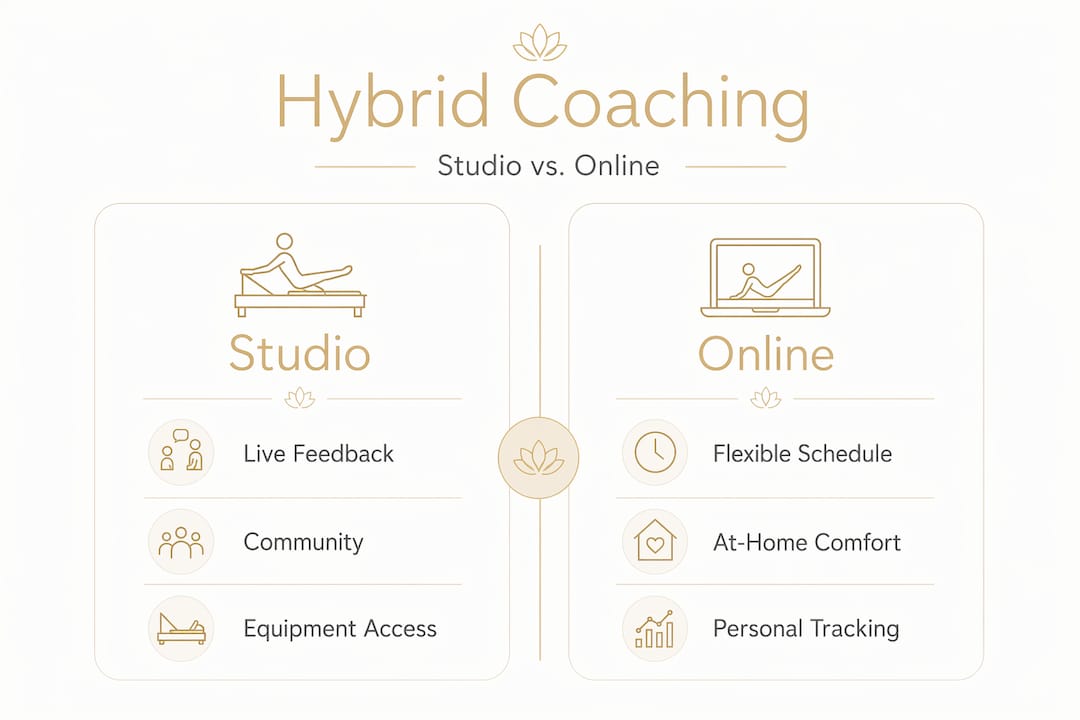
The practical effect on consistency is significant. Life gets in the way of studio attendance. Travel, illness, childcare, and work schedules all create gaps. A hybrid model fills those gaps rather than letting them become drop-off points.
| Approach | Schedule flexibility | Instructor connection | Equipment access | Drop-off risk |
|---|---|---|---|---|
| Studio only | Low | High | Full | High on disruption |
| Online only | High | Moderate | Minimal | Moderate |
| Hybrid model | High | High | Shared | Low |
The benefits of hybrid coaching at a practical level:
- Unified booking systems keep the client’s history visible to the instructor regardless of format
- Consistent cuing language reduces confusion between in-person and online sessions
- On-demand content fills recovery days without breaking momentum
- Progress tracks across formats, so nothing resets when you miss a studio week
- Instructors can adjust difficulty in real time across both settings
Consistent access to pilates essentials at home means the hybrid model works properly. Without some equipment at hand, the at-home portion of a hybrid program is limited to mat work only.
Practical benefits of online Pilates for health-conscious home exercisers
This is where the industry trend meets your actual life. Understanding why choose online Pilates becomes straightforward when you look at what it solves for people who exercise at home.
Online Pilates programs provide accessibility, personalization, and measurable health benefits, driving sustained engagement among health-conscious individuals.
The benefits stack up in a specific way for home exercisers:
- No commute, no schedule conflict. A 30-minute session at 6 a.m. or 9 p.m. is equally accessible. That removes the single biggest barrier to consistency.
- Space requirements are honest. A yoga mat footprint is genuinely enough for a full Pilates session. Compact resistance tools extend what is possible without adding floor space.
- Personalization is real, not marketed. A good online instructor adjusts programming to your injury history, goals, and current fitness level. That is harder to deliver in a large in-person class.
- Core strength and posture improvements are documented. Pilates is not vague about outcomes. It has a clear evidence base for core engagement, posture correction, and chronic pain management.
- Cost per session is lower. Online programs typically cost less than studio drop-in rates, making regular practice financially sustainable.
Pro Tip: Pair your online Pilates sessions with a compact resistance kit. Even a single set of resistance bands and a reformer-style strap system adds 30 or more exercises to what your instructor can program for you at home.
The pilates mini reformer kit is designed specifically for this use case. Compact, portable, and compatible with the kinds of exercises that translate directly from studio reformer work.
Why online Pilates teaching growth is more than a trend: it’s a sustainable fitness evolution
Here is the view most coverage misses. People frame the rise of virtual Pilates classes as a technology story or a convenience story. It is actually a retention story.
Every fitness format that has scaled online successfully did so because it kept people engaged long enough to see results. Pilates has that capacity built in. Its progression system is clear. Its results are tangible. And its instruction model, when done well, builds a coaching relationship that people do not want to exit.
The next phase of growth favors operators focused on long-term retention and sustainable scale, with integrated, personalized digital and physical experiences.
That means the instructors and platforms winning right now are not the ones with the most content. They are the ones with the strongest coaching relationships and the most coherent client journey. On-demand libraries alone do not hold people. A coach who knows your name, your injury history, and your goals does.
The impact of online fitness training is not that it made exercise more accessible. Plenty of formats did that. The real impact is that it forced a discipline like Pilates to clarify what makes it valuable. The answer turned out to be coaching quality, not location. That insight will outlast any particular technology trend.
For home exercisers, this means the Pilates Mini platform is not a substitute for good instruction. It is the equipment layer that makes good instruction more effective when it happens at home.
Explore Pilates Mini: Your portable home Pilates solution
Getting started with online Pilates at home is straightforward when you have the right equipment.
The Pilates Mini portable reformer kit is built for exactly this setup. Compact enough to store in a bag, it includes resistance bands, straps, and guided workout plans that pair directly with online instruction. The complete Pilates Mini starter kit gives you everything needed to follow along with a live or on-demand session without needing a full reformer. If you are setting up at home for the first time, the setup guide for Pilates Mini walks through installation on a standard doorway in minutes.
Frequently asked questions (FAQs)
Q: Why has online Pilates teaching become so popular recently?
A: Online Pilates surged because the practice adapted seamlessly to virtual formats during the pandemic, and two-way coaching technology then made those online classes genuinely effective rather than just convenient.
Q: Is online Pilates as effective as in-person classes?
A: With interactive two-way sessions, real-time form correction makes online Pilates comparable to studio classes for safety and progress, provided the instructor can see you clearly.
Q: Can online Pilates help with specific health issues like pregnancy-related pain?
A: Yes, Pilates is clinically supported for managing pregnancy-related musculoskeletal pain with no adverse effects, and online programs give those clients access to specialized guidance without requiring travel.
Q: How does hybrid Pilates coaching improve workout consistency?
A: Hybrid coaching unifies studio and online sessions under one client journey, so schedule disruptions fill with at-home sessions rather than becoming drop-off points.
Q: What makes Pilates ideal for online home workouts?
A: Pilates clients want studio-quality instruction with flexibility, and online programs deliver exactly that. Minimal space, precise form-based coaching, and compact equipment make it one of the best-suited formats for effective home practice.